
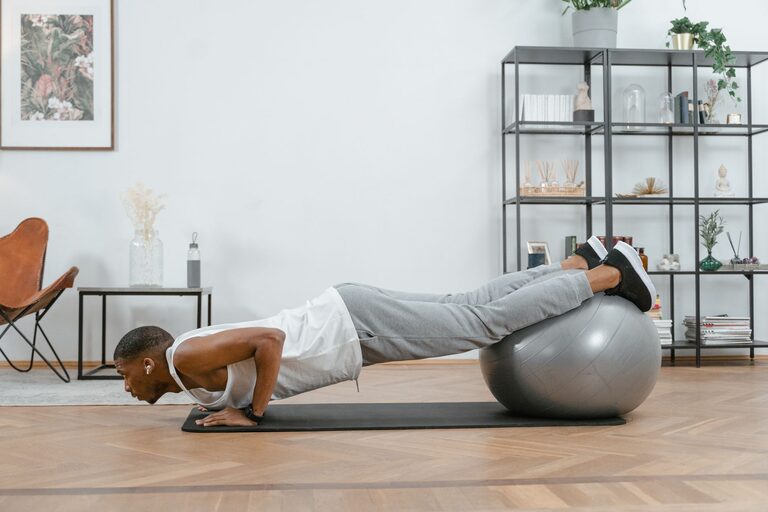
Good balance helps you move with greater control during everyday activities, from walking across a room to reaching for an item on a shelf. Stability also supports better posture, coordination, and confidence in movement.
You do not need special equipment or a gym membership to work on these skills. A few simple exercises, practiced regularly in a safe space, can make a useful addition to your daily routine.
Start With a Safe Space
Before exercising, prepare an area where you can move comfortably and reduce the chance of tripping.
– Remove loose rugs, cords, toys, and other obstacles.
– Choose a level, nonslip surface.
– Keep a sturdy chair, countertop, or wall nearby for support.
– Wear comfortable clothing and secure footwear.
– Make sure the area has good lighting.
– Avoid exercising when you feel unusually tired, dizzy, or distracted.
Support is not a sign that you are doing an exercise incorrectly. Holding a stable surface can help you focus on controlled movement while you gradually build confidence.
Practice Good Posture
Balance begins with body alignment. Stand tall with your head level, shoulders relaxed, and chest comfortably open. Keep your feet about hip-width apart unless an exercise calls for a different position.
Try not to lock your knees or lean heavily to one side. Keep your weight spread across your feet and look straight ahead. Slow, controlled movement is usually more useful than rushing through repetitions.
A simple posture check can help:
- Place your feet evenly on the floor.
- Relax your shoulders away from your ears.
- Keep your chin level.
- Lightly engage your stomach muscles.
- Breathe steadily as you move.
Try These Simple Balance Exercises
1. Weight Shifts
Weight shifts are a gentle way to become more aware of how your body moves.
Stand behind a sturdy chair and place your hands on the backrest. Slowly shift your weight toward your right foot without lifting your left foot. Return to the center, then shift toward your left foot.
Repeat the movement 8 to 10 times on each side. Keep your upper body tall and avoid leaning too far.
You can also shift your weight forward and backward. Move gently toward the balls of your feet, then back toward your heels while keeping your feet flat.
2. Heel Raises
Heel raises strengthen the lower legs and encourage control through the feet and ankles.
Hold a chair or countertop. Slowly lift both heels so you rise onto the balls of your feet. Pause briefly, then lower your heels with control.
Begin with 8 to 12 repetitions. As the exercise becomes easier, try lifting and lowering more slowly. Keep your weight balanced between both feet.
3. Toe Raises
Toe raises work the muscles at the front of the lower legs and help you practice shifting weight toward your heels.
Stand tall while holding a stable surface. Keep your heels on the floor and lift your toes. Lower them slowly and repeat 8 to 12 times.
Avoid leaning backward. The movement should be small and controlled.
4. Sit to Stand
This functional exercise uses the same movement you need when getting up from a chair.
Choose a firm chair that does not slide. Sit near the front of the seat with your feet flat and about hip-width apart. Lean forward slightly, press through your feet, and stand. Pause, then bend your knees and slowly lower yourself back into the chair.
Use your hands for support if needed. Try 6 to 10 repetitions, focusing on smooth movement rather than speed.
5. Marching in Place
Marching helps improve coordination and control while shifting weight from one foot to the other.
Stand near a countertop or sturdy chair. Lift one knee a few inches, lower it, and then lift the other knee. Continue at a comfortable pace for 20 to 30 seconds.
Keep your torso upright and avoid swinging your body from side to side. As your control improves, pause briefly each time one foot is lifted.
6. Heel to Toe Walk
This exercise challenges balance by narrowing your base of support.
Stand near a wall or countertop. Place one foot directly in front of the other, as if walking along a straight line. Take 5 to 10 slow steps, looking ahead rather than down at your feet.
Keep a hand close to your support surface. If the position feels difficult, leave a small gap between your feet instead of placing them directly heel to toe.
Add Strength and Flexibility
Balance is not only about standing on one foot. Strong legs, flexible ankles, and a stable core can all contribute to better control.
Consider adding these simple movements:
– Wall pushups: Place your hands on a wall and perform a controlled pushup to work the upper body.
– Supported side leg lifts: Hold a chair and slowly move one leg out to the side without tilting your torso.
– Supported leg curls: Hold a chair and bend one knee to bring your heel gently toward the back of your leg.
– Ankle circles: Sit down and slowly circle each ankle in both directions.
– Gentle calf stretches: Place one foot behind the other and keep the back heel down as you lean forward slightly.
Move only within a comfortable range. Stretching should feel gentle, not painful.
Build a Simple Weekly Routine
Consistency matters more than doing a long workout once in a while. Start with 10 to 15 minutes on three or four days each week.
A sample routine could include:
- One minute of relaxed marching or walking.
- Ten weight shifts in each direction.
- Ten heel raises.
- Six to ten sit-to-stand repetitions.
- Twenty seconds of marching in place.
- A few gentle ankle and calf stretches.
Rest between exercises as needed. Over time, you can slowly add repetitions or increase the amount of time you practice. Change only one part of the routine at a time so you can notice how your body responds.
Make Everyday Activities More Active
You can practice stability during normal routines without setting aside a full workout.
– Stand tall while brushing your teeth, keeping one hand near the counter.
– Rise from a chair without pushing off the armrests when it feels comfortable.
– Walk at a steady pace and pay attention to your foot placement.
– Use stairs carefully and hold the handrail.
– Practice reaching in different directions while keeping both feet grounded.
Avoid standing on one foot or closing your eyes unless you are working with a qualified professional in a properly supervised setting. These changes can make an exercise much more challenging.
Listen to Your Body
Stop an exercise if you feel sharp pain, unusual weakness, chest discomfort, or lightheadedness. Take a break and return to an easier movement when you feel ready. If balance problems are new, worsening, or affecting daily activities, consider speaking with a qualified health or fitness professional before starting a new routine.
Improving balance is a gradual process. With a clear space, steady practice, and controlled movements, simple exercises at home can help you feel more aware and confident in the way you move.